
Watch a mini excavator work in a tight space, and one motion stands out above the rest: the whole upper body spins smoothly on its base, dig after dig, without ever tangling a hose or reaching a stopping point. The operator digs to the front, rotates a quarter turn, dumps into a truck, then swings back to the trench, and the machine repeats that arc hundreds of times a shift. That continuous, full-circle rotation is one of the defining features of an excavator, and it looks so effortless that few operators stop to ask how it actually happens. Behind the ease sits a clever combination of a purpose-built bearing, a hydraulic motor, and a fluid path engineered to feed a body that never stops turning.
Understanding how the swing works pays off well beyond curiosity. The swing system shapes how fast you cycle, how smoothly you place a load, and how much of a tight site you can reach without repositioning the tracks. When you know what makes the upper structure rotate and what governs its speed and force, you read spec sheets with sharper eyes and spot the machines built to hold up under years of constant swinging. This post walks through each part of the system in turn, then closes with a practical framework for judging swing performance before you buy.
How the Slewing Ring Enables Full Rotation
The heart of a mini excavator's swing is the slewing ring, sometimes called the swing bearing or turntable bearing. It sits between the upper structure, known as the house, and the undercarriage that carries the tracks. This large circular bearing does two jobs at once: it carries the entire weight of the house, boom, arm, and any load, and it lets that whole assembly rotate freely on top of the tracks. Without it, the upper body would be bolted rigidly to the base, and the machine could only dig wherever the tracks happened to point.
The slewing ring is engineered to handle forces pulling in several directions at the same time. As the excavator digs and lifts, the load tries to tip the house forward, push it down, and twist it, all while the bearing must still turn smoothly. To manage this, the ring uses hardened raceways and rows of balls or rollers that spread these combined loads around the full circle. One part of the ring bolts to the house and the other to the undercarriage, so the two halves rotate relative to each other on those rolling elements. This design is what allows a compact machine to lift and swing heavy loads off to the side without the bearing binding or failing.
Just as important, the inner or outer edge of the slewing ring carries gear teeth. These teeth are what the swing motor grabs onto to turn the house, which ties the bearing directly into the powered motion. The ring, then, is not a passive part. It is both the structural pivot the machine rotates around and the geared surface that the drive system pushes against to create the swing.
Key takeaway: The slewing ring is the load-bearing, geared pivot that both supports the upper structure and lets it rotate freely on the undercarriage, forming the foundation of full 360-degree swing.
How the Hydraulic Swing Motor Powers the Motion
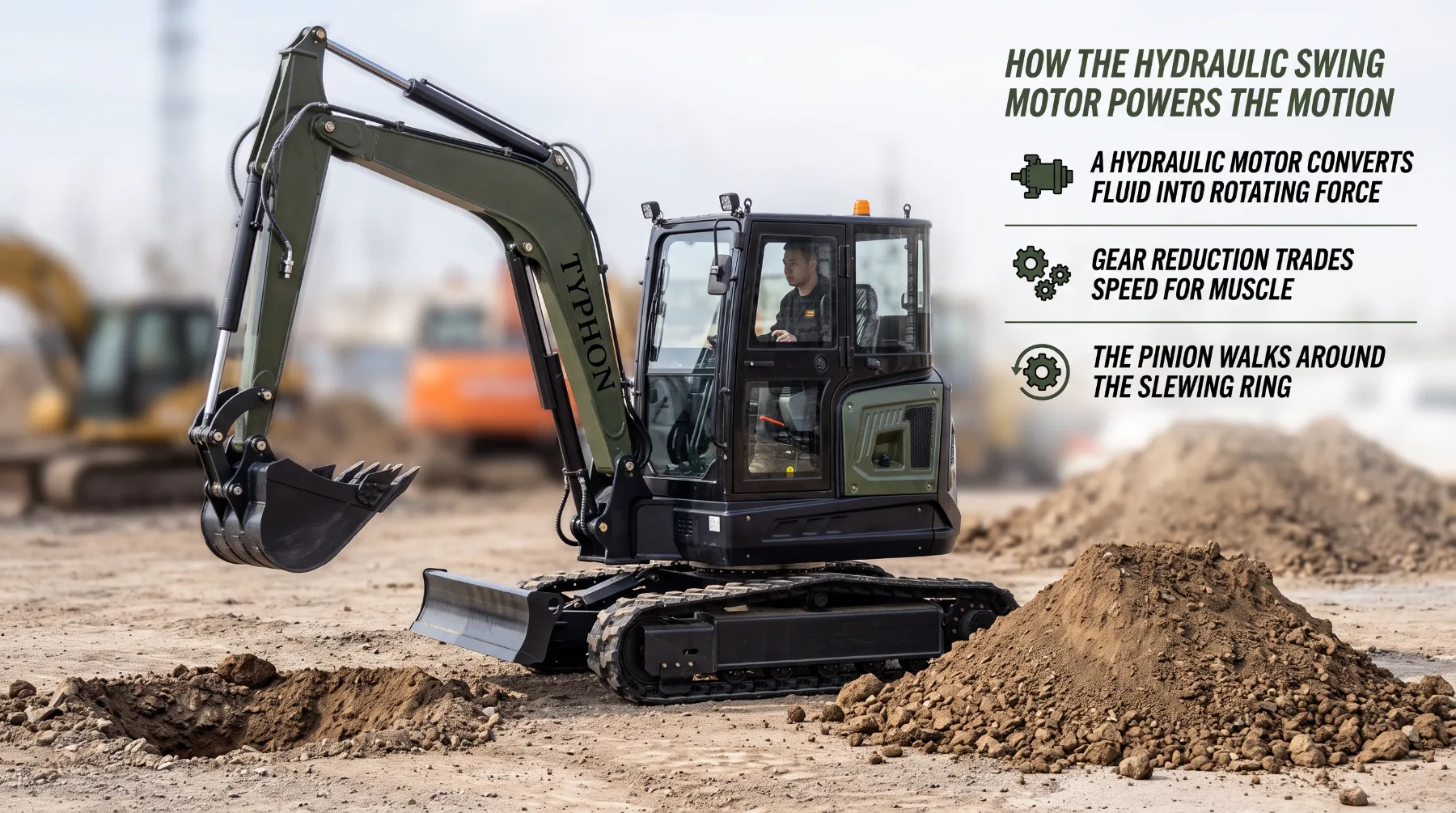
The slewing ring provides the path for rotation, but something has to drive the house around that circle, and on a mini excavator that job belongs to the hydraulic swing motor. This motor is a compact, powerful unit mounted on the house, and it converts the flow and pressure of hydraulic fluid into rotating force. When the operator moves the joystick to swing, pressurized fluid enters the motor, spins its internal components, and produces torque at the output shaft.
That output shaft doesn't turn the house directly, because the raw speed of the motor would be far too fast and its force too modest for the work. Instead, the shaft drives a gear reduction unit, often a planetary gearset, that trades speed for muscle. The reduction gearing slows the rotation to a controlled pace while multiplying the torque many times over. The final gear in this train, the swing pinion, meshes with the teeth on the slewing ring. As the pinion turns, it walks itself around the fixed ring gear, and because the motor and pinion are mounted to the house, the whole upper structure rotates with them.
This arrangement gives the operator both the strength to swing a loaded bucket uphill or against a slope and the finesse to feather the house into a precise position. The swing motor also typically includes a brake that holds the house steady when no swing command is given, so the upper structure doesn't drift or coast freely once the operator releases the joystick. That combination of powered rotation and controlled holding is what makes the swing feel deliberate rather than loose.
Key takeaway: The hydraulic swing motor turns fluid pressure into rotating force, and through gear reduction and the swing pinion it drives the house around the slewing ring with both strength and precision.
How Swing Speed and Torque Are Managed
Two qualities define how a mini excavator swings: how fast the house can rotate and how much force it can apply while turning. These are swing speed and swing torque, and they pull in opposite directions, so the hydraulic and gearing design has to strike a sensible balance between them. Swing speed, usually stated in revolutions per minute, determines how quickly the operator can rotate from the dig to the dump and back. Swing torque determines how forcefully the house can start turning, hold a load against a slope, or push through resistance without stalling.
The gear reduction between the swing motor and the slewing ring is where much of this balance is set. More reduction yields higher torque but lower speed, while less reduction gives quicker rotation with less turning force. Manufacturers tune this ratio to suit the size and purpose of the machine, so a compact digging excavator gets enough torque to swing loaded buckets confidently while still rotating briskly enough for productive cycles. The flow of hydraulic fluid the pump can supply also caps the top swing speed, since the motor can only turn as fast as the fluid feeding it allows.
Just as important as raw numbers is how smoothly the swing starts and stops. A well-designed system accelerates the house progressively rather than jerking it into motion, and it decelerates it in a controlled way so the load doesn't overshoot or sway. Cushioning built into the hydraulic circuit absorbs the shock at the ends of a swing, protecting both the machine and the precision of load placement. The swing brake then holds the house firmly once it settles. Together, these controls turn what could be a crude spin into a smooth, repeatable motion the operator can trust load after load.
Key takeaway: Swing speed and swing torque are balanced through gear reduction and hydraulic flow, and smooth acceleration, controlled stopping, and a reliable brake turn that balance into precise, dependable rotation.
How 360-Degree Swing Boosts Productivity on Confined Sites
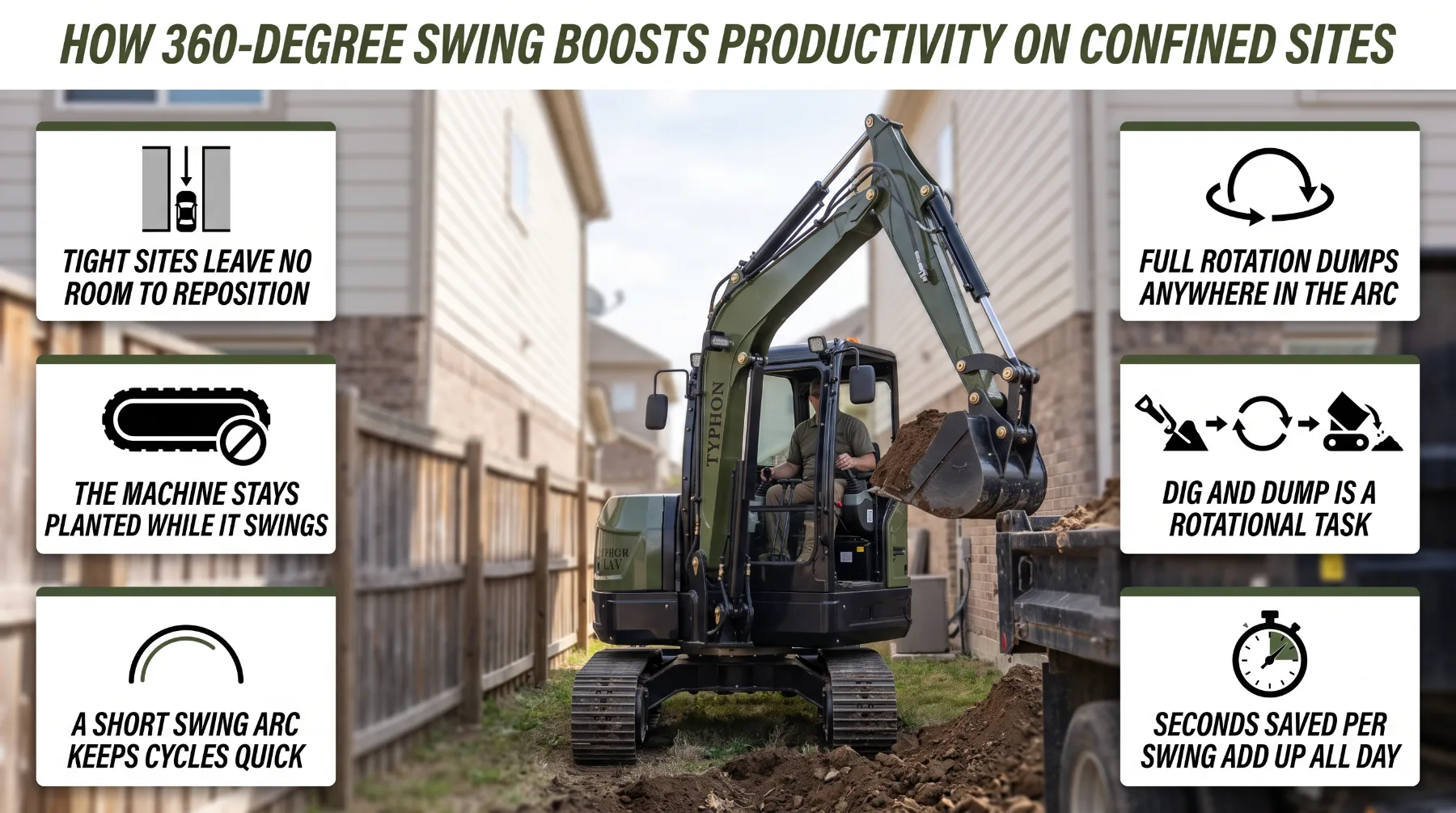
The real payoff of continuous swing shows up on the crowded, tight sites where mini excavators earn their keep. In a narrow trench between buildings, a fenced backyard, or a busy urban footprint, there is rarely room to drive the machine back and forth to reposition. Full rotation lets the operator dig in one spot and place the spoil, or load a truck, anywhere in the surrounding circle without moving the tracks at all. That ability to swing rather than shuffle is what makes these machines so productive in spaces where a larger, less nimble machine simply couldn't work.
This capability speeds up the most common work cycle dramatically. Digging and dumping is fundamentally a rotational task: cut a bucketful, swing to the pile or truck, release, and swing back. When the house turns a full circle freely, the operator can position the dump exactly where it's most convenient, keeping the swing arc short and the cycle quick. Over a full day of trenching or loading, shaving a second or two off each swing adds up to real gains in material moved, and it does so while the machine stays planted on stable ground rather than repeatedly starting, stopping, and repositioning.
Many mini excavators pair full swing with another confined-space feature: a reduced or zero tail swing design, where the counterweight stays within or barely beyond the track width as the house rotates. This lets the operator swing freely alongside walls, fences, and traffic without the rear of the machine sweeping into obstacles behind it. Combined with 360-degree rotation, this design lets a mini excavator work safely and efficiently right up against boundaries that would force a conventional machine to stop and reposition constantly. The swing system, in short, is a large part of why these compact machines are the tool of choice wherever space is at a premium.
Key takeaway: Continuous 360-degree swing lets a mini excavator dig and place material anywhere around it without repositioning, and paired with reduced tail swing it delivers fast, safe cycles in the tight spaces these machines are built for.
Conclusion
A mini excavator's 360-degree swing is the product of several components working in concert rather than any single clever part. The slewing ring provides the geared, load-bearing pivot that both supports the upper structure and lets it rotate. The hydraulic swing motor, through gear reduction and the swing pinion, drives the house around that ring with a balance of strength and finesse. The center swivel joint feeds fluid across the boundary between the fixed undercarriage and the turning house right on the axis of rotation, which is what makes truly continuous, full-circle swing possible without twisting a single hose. The house and undercarriage divide the work of digging and moving, with the counterweight and track geometry keeping the machine stable through every turn. Careful management of swing speed, torque, and smooth control turns that rotation into precise, repeatable motion, and the whole system pays off most on the confined sites where these machines shine. Understand how it all fits together, weigh the swing specifications against your real work, and you'll choose a machine that rotates smoothly and dependably shift after shift.
Frequently Asked Questions
Why don't the hydraulic hoses twist and break when a mini excavator swings in full circles? The center swivel joint, also called a rotary manifold or center joint, allows hydraulic fluid to pass between the stationary undercarriage and rotating house. It sits directly on the slewing axis, so the upper section can rotate continuously without twisting the hydraulic lines. Sealed internal passages transfer fluid to components such as the track motors. This is what allows the excavator to make full 360-degree swings without running out of hose slack.
What is the difference between the house and the undercarriage on a mini excavator? The undercarriage is the lower section, including the tracks, track frames, travel motors, and often the dozer blade. It supports and moves the machine. The house is the upper section, containing the cab, engine, hydraulic pumps, counterweight, boom, arm, and bucket. A slewing ring connects the two and allows the house to rotate independently above the undercarriage. This lets the machine remain planted while the upper structure swings to dig and place material.
Does a faster swing speed always mean a better mini excavator? Not necessarily. Faster swing speeds can shorten cycles during trenching and loading, but swing speed must be balanced with swing torque and smooth control. A machine that rotates quickly but starts or stops abruptly can make precise placement more difficult. A well-balanced excavator combines suitable swing speed with strong torque, controlled acceleration and braking, and stable operation. Choose swing performance based on the type and pace of work you actually perform.