
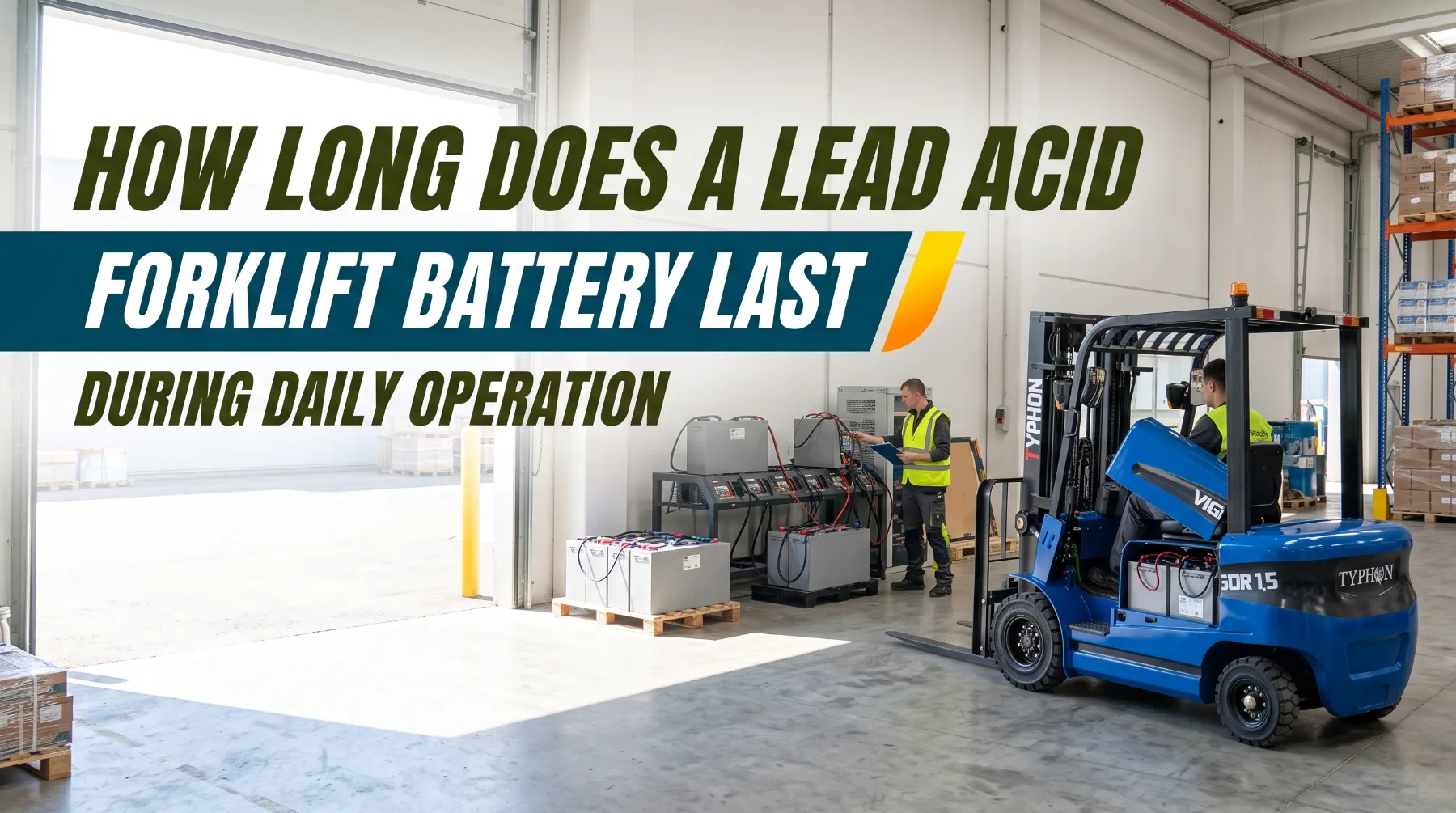
A warehouse supervisor watches a forklift slow to a crawl two hours before the shift ends, its lift barely clearing the racking, and knows the day is about to fall behind. The operator swears the battery was fully charged that morning, and the meter agreed. Yet here it sits, drained early, with pallets still waiting and a truck at the dock. Scenes like this play out in countless facilities, and they rarely trace back to a faulty battery. More often they come down to a simple gap in understanding how long a lead acid forklift battery is actually built to run, and what quietly eats into that runtime long before the warning light comes on. Knowing what to expect from a battery over a day, and over its years of service, is the difference between a fleet that hums along and one that stalls when the pressure is highest.
Battery runtime tends to get treated as a fixed number, a figure printed on a label and trusted without question. The reality is far more fluid, shaped by how the battery is used, charged, and cared for every single day. This post looks at what affects daily runtime, what a typical shift really demands, how charging cycles shape a battery's working life, how temperature and workload change its behavior, what habits stretch its lifespan, and how to read battery specs when choosing a forklift.
What Affects Daily Runtime
A lead acid forklift battery's daily runtime rests on the relationship between its capacity and the work it is asked to do. Capacity, measured in ampere-hours, describes how much energy the battery holds when fully charged, and a larger capacity generally means more hours of work between charges. But the battery's age and condition matter just as much, because a well-maintained cell delivers close to its rated capacity while a neglected or aging one falls short, sometimes dramatically. Two forklifts with identical batteries can post very different runtimes if one battery has been watered, cleaned, and charged properly while the other has been run hard and left dry.
The demands placed on the battery through the shift shape the rest of the picture. A forklift lifting heavy loads to full height, traveling long distances, and cycling constantly draws far more current than one making light, occasional moves. Attachments, ramps, and cold storage all pull extra energy as well. This is why a single battery might run a full eight hours in a light-duty operation yet fade after five in a demanding one. Runtime is never a fixed figure printed on a label. It is the result of capacity, condition, and the intensity of the work, all interacting through the course of a working day.
Key takeaway: Daily runtime depends on the battery's capacity and condition together with how hard the forklift works, so the same battery can deliver very different hours depending on load, distance, and maintenance.
Typical Shift Life Expectations
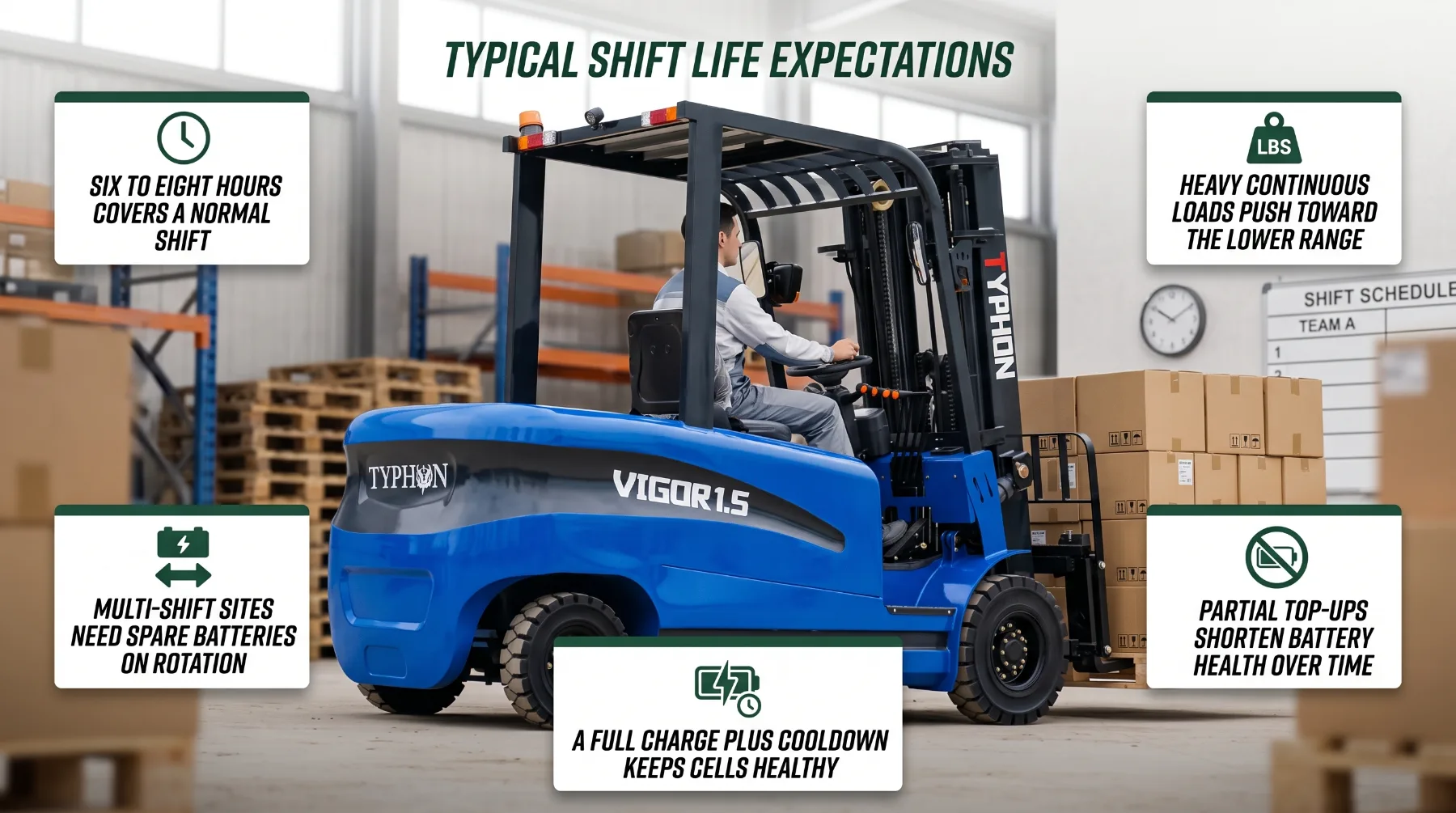
Most lead acid forklift batteries are designed around a single working shift, and that design goal shapes what you can reasonably expect from one. A healthy, properly sized battery is built to run roughly six to eight hours of normal operation on a full charge, which covers a standard shift with enough margin for breaks and lighter periods. That figure assumes the battery is in good condition and matched sensibly to the work. In practice, operations that push heavy loads continuously often see the lower end of that range, while lighter, more intermittent work can stretch toward the upper end or beyond.
The trouble starts when a facility tries to force a single-shift battery through two or three shifts without a plan. A lead acid battery cannot simply be topped up whenever convenient without consequences, because it needs a full charge followed by a cooling period to stay healthy. Operations running around the clock typically keep spare batteries and swap them between shifts, letting each one charge and rest while another works. Understanding that a lead acid battery is fundamentally a one-shift-then-recharge tool, rather than an all-day-every-day power source, is the key to setting realistic expectations and avoiding the mid-shift slowdowns that catch operations off guard.
Key takeaway: A healthy lead acid forklift battery is built to run about six to eight hours per charge, covering one shift, so multi-shift operations need spare batteries and a swap plan rather than constant topping up.
How Charging Cycles Impact Lifespan
Every lead acid battery has a finite number of charge cycles in it, and how those cycles are handled decides whether the battery reaches its full potential or wears out early. A charge cycle is essentially one meaningful discharge followed by a recharge, and most lead acid forklift batteries are rated for somewhere around 1,000 to 1,500 cycles under good conditions. Used sensibly, that translates to roughly five years of service, though the real number depends heavily on daily habits. The single most damaging habit is discharging the battery too deeply, since draining it below about 20 percent of its capacity strains the cells and shortens its life with every occurrence.
How and when the battery is charged matters just as much as how far it is drained. Interrupting a charge partway through, a practice known as opportunity charging on a battery not designed for it, prevents the cells from completing the chemical process they rely on and steadily erodes capacity. Lead acid batteries also generate heat during charging and need time to cool, so charging once fully after a shift and allowing a rest period is far kinder than repeated partial top-ups through the day. Treating each charge cycle with care, letting the battery discharge to a sensible level and then recharge fully, is what allows it to deliver the thousand-plus cycles it was built for rather than failing years ahead of schedule.
Key takeaway: Lead acid batteries last a set number of charge cycles, usually around 1,000 to 1,500, and avoiding deep discharges and partial charges is what lets a battery reach roughly five years of service instead of failing early.
How Temperature and Load Intensity Affect Performance
Temperature has a powerful and often underestimated effect on how a lead acid battery performs day to day. Cold conditions slow the chemical reactions inside the cells, which reduces the capacity available and shortens runtime, so a battery that lasts a full shift in a warm warehouse may fade noticeably in a refrigerated one. Heat cuts the other way, boosting short-term output slightly but accelerating wear and shortening overall lifespan, especially when a battery is charged while already hot. The most reliable performance comes from operating and charging within a moderate temperature range, which is exactly why cold storage and hot climates both demand extra attention to battery management.
Load intensity works alongside temperature to shape both runtime and long-term health. A forklift lifting near its rated capacity, climbing ramps, or running hard-charging duty cycles draws heavy current, which drains the battery faster and generates more internal heat. Sustained high demand not only shortens a single shift's runtime but adds cumulative stress that wears the battery over time. Lighter, steadier work is far gentler, letting the same battery deliver more hours and more years. Reading the combination of temperature and workload honestly is essential, because a battery sized comfortably for light duty in mild conditions can struggle badly under heavy loads in the cold, leaving an operation short of power when it least expects it.
Key takeaway: Cold reduces runtime while heat accelerates wear, and heavy loads drain and stress a battery faster, so temperature and workload together determine both daily performance and long-term life.
Best Practices for Extending Battery Life
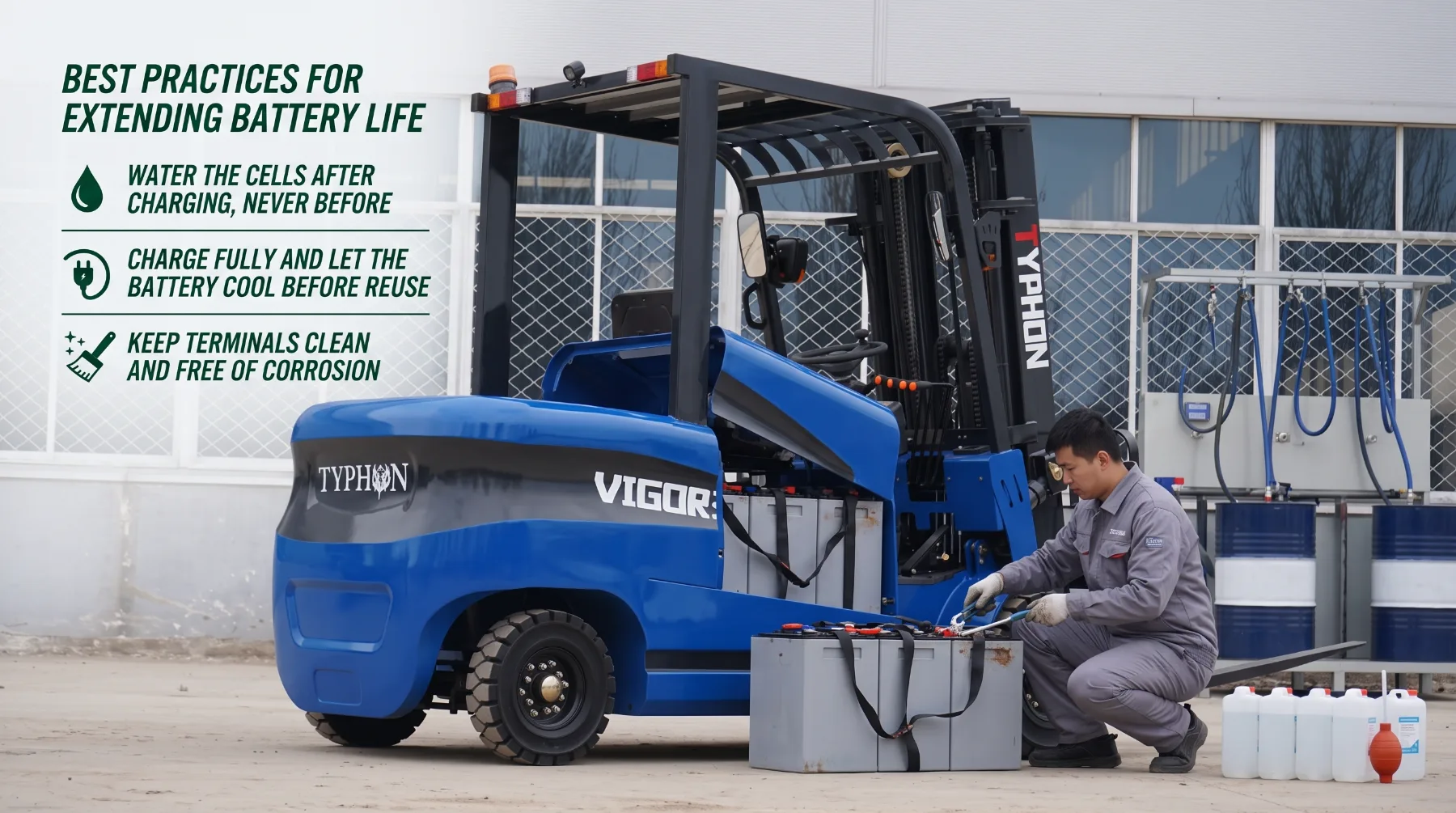
Getting the most from a lead acid forklift battery comes down to a handful of consistent habits that protect the cells day after day. Watering sits at the top of the list, because lead acid batteries lose water during charging and the plates must stay submerged to work properly. Checking and topping up the electrolyte with distilled water on a regular schedule, always after charging rather than before, keeps the cells healthy and prevents the permanent damage that comes from running them dry. Keeping the battery clean and its terminals free of corrosion matters too, since buildup can cause poor connections, energy loss, and even safety hazards.
Charging discipline protects the battery just as much as watering does. Charge the battery fully after a shift rather than snatching partial top-ups, avoid running it below a sensible charge level, and let it cool properly before putting it back to work. Equalizing charges, performed periodically according to the manufacturer's guidance, help balance the cells and clear off buildup that reduces capacity over time. Storing and operating the battery within a moderate temperature range shields it from the extremes that shorten life. None of these habits is complicated, but together they routinely add years to a battery's service and keep its daily runtime strong, recovering much of the value that a careless approach quietly throws away.
Key takeaway: Regular watering with distilled water, clean terminals, full charges with cooling periods, periodic equalizing, and moderate temperatures are the core habits that extend a lead acid battery's runtime and years of service.
How to Evaluate Battery Specs When Choosing a Forklift
When a forklift's real job is to run reliably through your shifts, the battery specifications deserve careful attention rather than a passing glance. Start with capacity in ampere-hours, since that figure drives how many hours of work the battery delivers between charges. Match it honestly against your actual workload, not a best-case estimate, because a battery sized for light duty will fall short under heavy loads or in the cold. Look at the voltage as well, which needs to suit the forklift and the demands of the work, and consider the battery's physical size and weight, since on many forklifts the battery also serves as counterweight and must fit the compartment correctly.
From there, weigh the specifications that speak to long-term value. Check the rated cycle life, since a battery built for more charge cycles will serve longer under the same use, and factor in the maintenance the battery demands against the resources you have to care for it. Consider your operation's shift pattern honestly, because a single-shift battery and a multi-shift setup with spares and rotation are very different commitments. Think about your working temperatures too, since cold storage or hot environments call for extra capacity and careful management. Wherever possible, look at how a battery performs in an operation like your own, running loads and hours similar to yours, since real-world results reveal far more than a spec sheet about whether a battery will carry your shifts with confidence.
Key takeaway: Match capacity and voltage to your real workload, confirm the battery fits and counterweights the forklift, weigh cycle life and maintenance needs, and account for your shift pattern and temperatures before choosing.
Conclusion
A lead acid forklift battery's daily life is far more than a single number on a label. Its runtime flows from the balance between capacity and workload, its years of service from how carefully each charge cycle is handled, and its day-to-day reliability from temperature, load intensity, and consistent maintenance. A healthy, well-matched battery is built to carry a single shift of roughly six to eight hours and, treated well, to deliver around five years and well over a thousand charge cycles before it needs replacing. The operations that get the most from their batteries are rarely the ones with the biggest capacity on paper. They are the ones that size the battery sensibly, charge it with discipline, water and clean it on schedule, and respect the conditions it works in. Do that, and the mid-shift slowdown that catches so many facilities off guard simply stops happening.
Frequently Asked Questions
How many hours should a lead acid forklift battery last on a single charge? A properly sized lead acid forklift battery typically provides about 6–8 hours of runtime on a full charge. Actual runtime depends on workload, travel distance, load weight, and battery condition. Heavy, continuous operation can reduce runtime, while lighter work may extend it. Track actual runtime under your normal workload to plan shifts more accurately.
How long will a lead acid forklift battery last before it needs replacing? A lead acid forklift battery is typically rated for around 1,000–1,500 charge cycles, often translating to about 5 years of service when properly maintained. Deep discharges, frequent partial charging, and poor maintenance can shorten its life. Regular watering with distilled water, clean terminals, full charging, cooling periods, and periodic equalizing charges help maximize battery life.
Why does my forklift battery lose runtime in cold storage? Cold temperatures slow the chemical reactions inside a lead acid battery, reducing usable capacity and shortening runtime. Heavy workloads can make the effect more noticeable. For cold-storage operations, consider extra battery capacity and charge within a moderate temperature range when possible. Managing both temperature and workload helps maintain more consistent runtime.