
How Long Does It Take to Learn to Operate a Mini Excavator?
Saturday morning, a first-time buyer wheels a 2.7-ton mini excavator off the trailer, ready to dig a drainage trench across his own backyard by nightfall. Climbing in the cold, he grabs both joysticks and swings the boom the wrong direction twice before the bucket ever reaches the dig line. By Sunday evening, though, that same operator is cutting a straight, usable trench and starting to feel the controls answer like an extension of his own hands. Watching that weekend arc, from clumsy to functional, raises the question every new operator asks before the first job: how long until this machine actually earns its keep instead of fighting me?
Honest answers depend on a handful of factors, and this guide lays them out plainly. Learning a mini excavator happens in stages, moving from grasping the controls, to hitting safe competency, to reaching the smooth, fast rhythm that paying work demands. Below, you'll see what shapes your personal timeline, how the controls actually work, the milestones to expect, practical ways to speed things up, and why real training pays back in both safety and return. Here's a realistic look at the road from beginner to productive.
What Shapes Your Personal Timeline
No single number fits everyone, because several variables decide how quickly you pick up a mini excavator. Prior seat time on heavy equipment counts for the most: an operator who's run a skid steer or a backhoe already understands hydraulic controls and job-site awareness, so they climb the curve far faster than a total newcomer. Starting from zero simply takes longer, and there's nothing wrong with that.
Machine size and control pattern factor in too. Compact 1-ton units forgive fumbled inputs more gently than a heavier 4-ton machine, and the control pattern you train on, ISO or SAE, shapes how fast your hands build muscle memory. Job complexity forms the third big variable. Cutting a straight trench in open dirt sits worlds apart from fine grading around live utilities or working across a slope.
Practical takeaway: be honest about your starting point. Someone with backhoe experience learning a mini excavator on simple trenching might feel comfortable within a day, while a first-timer tackling precision work should plan for weeks. Matching your expectations to reality keeps frustration low and steady progress in view.
Getting Comfortable With the Controls
Understanding the layout is the first real hurdle, and most mini excavators share a common setup once you know what each input does. Two joysticks handle the digging functions: boom, stick (or dipper), bucket curl, and house rotation. Foot pedals or levers drive the tracks, and a separate lever or pedal usually controls the boom swing or the dozer blade.
That combination sounds like a lot to juggle, and at first it truly is. Each joystick controls two functions depending on the direction you push, so one hand manages both the boom and the swing at the same time. Coordinating both hands to dig, lift, swing, and dump in one smooth cycle is the skill that separates a beginner from a competent operator, and it comes only through seat time.
Picture a basic dig-and-dump cycle: drop the boom, curl the bucket to fill it, raise the boom, swing to the spoil pile, then dump. Beginners perform each step separately, pausing between motions. Repetition eventually blends those steps into one flowing movement. Lock in control familiarity early, so spend your first hours making slow, deliberate motions rather than rushing to dig fast.
Hitting Safe, Basic Competency
Reaching basic competency, the point where you can safely handle simple tasks on your own, usually arrives faster than new operators expect. Most people running a mini excavator for the first time can manage straightforward digging, trenching, and material moving after roughly 8 to 16 hours of focused seat time. That works out to one or two solid days of practice on an easy site.
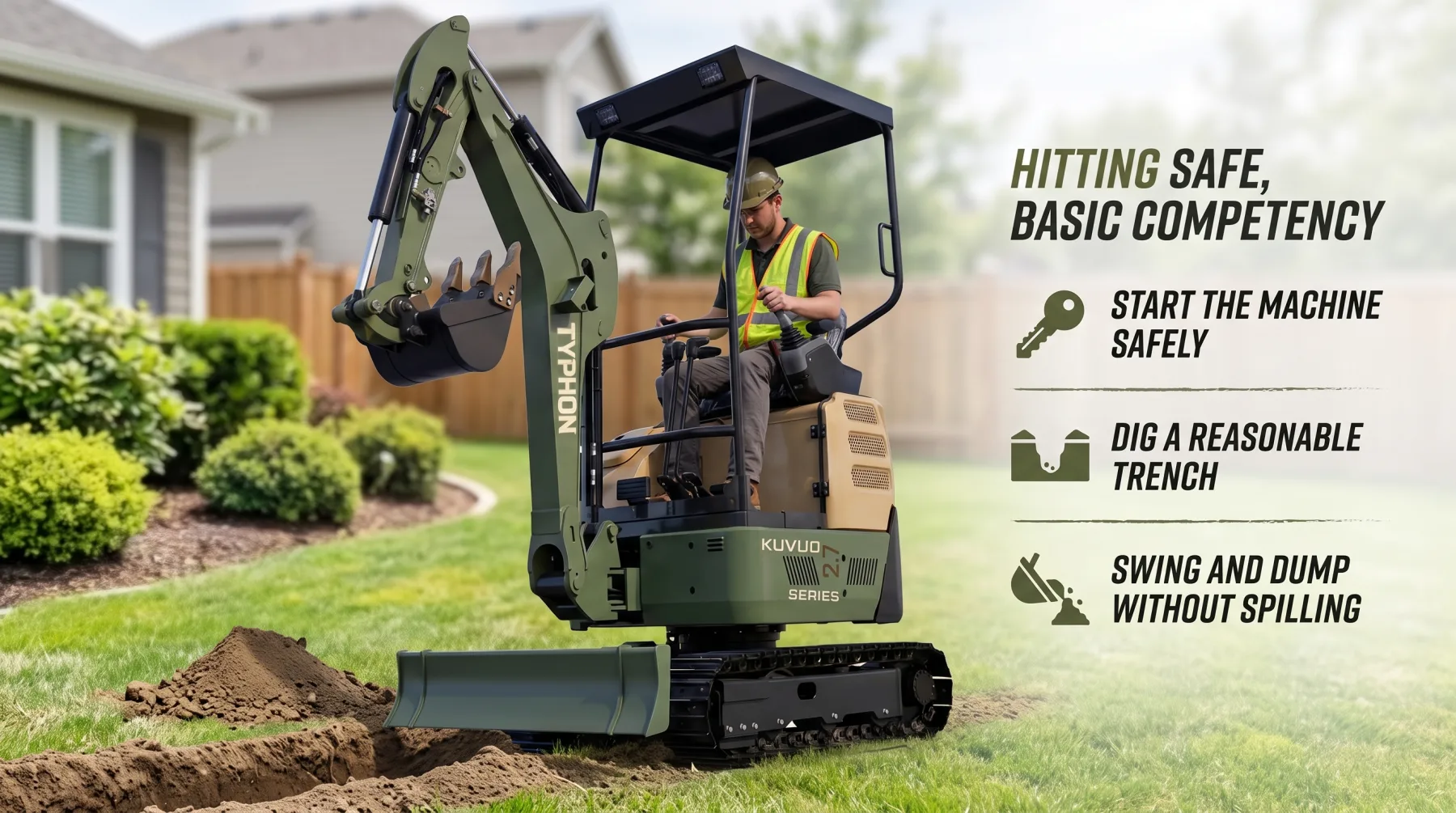
What does "basic competency" really mean here? It means you can start the machine safely, travel it without jerking, dig a reasonable trench, swing and dump without spilling half the load, and stop without drama. Speed and finesse won't be there yet, but you'll be functional and, more importantly, safe on simple work.
Consider a homeowner or a new crew member digging footings or a utility trench in open ground. Following a day of guided practice, they can usually get real work done, just slowly and with plenty of small corrections. Treat that early competency as a genuine milestone, permission to tackle simple jobs, not a sign you've mastered the machine.
Building Up to Production Speed
Production proficiency is a different animal, and this is where honesty matters most. Being able to dig is not the same as digging fast, clean, and all day without tiring, which is exactly what a paying job demands. Reaching that level typically takes weeks to a few months of regular operation, often landing in the range of 100 to 200 hours in the seat.
Why such a gap between competent and proficient? Speed, precision, and efficiency all grow out of repetition. Proficient operators read the soil, plan each cycle, place spoil exactly where it belongs, and grade to a clean finish without constant back-and-forth. Those instincts build slowly, one job at a time, until the machine feels automatic and your attention shifts from the controls to the work itself.
Take a contractor cutting a foundation or grading a pad. Competent operators get there eventually; proficient ones do it faster, cleaner, and with far less rework, which is precisely what makes the machine profitable. Patience is the lesson: budget real hours before you count on production speed, and hold off on bidding tight jobs until your output is dependable.
Habits That Shorten the Learning Curve
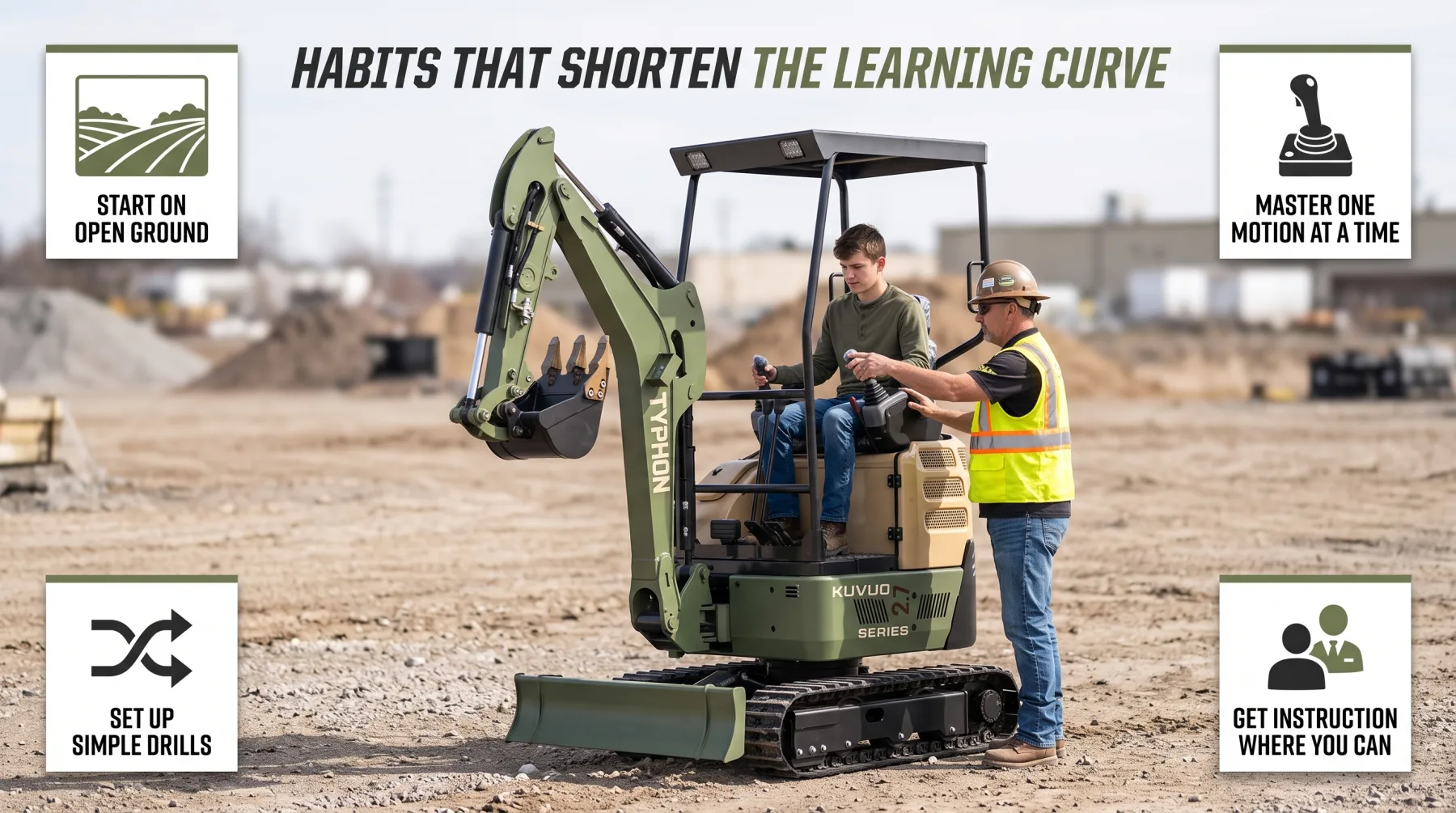
Certain habits shave weeks off the road to proficiency, and using them from day one saves both time and frustration. Rather than diving straight into paid work, invest a few hours building fundamentals deliberately. These practices consistently move new operators along faster:
Beyond the drills, mindset matters more than most people admit. Slow, smooth inputs teach your hands faster than fast, jerky ones, since ragged control only reinforces mistakes. Rushing to look productive early actually slows real learning. Give yourself permission to be slow at first, and the speed follows naturally once the coordination locks in.
One more habit pays off: end each session by reviewing what felt awkward. Reflecting on the motions that gave you trouble points to your next practice session where it counts, which turns raw seat time into targeted improvement. A common mistake worth naming: jumping onto slopes, tight spots, or work near buried utilities before the basic cycle feels automatic, since combining an unfamiliar machine with a high-stakes environment is how new operators strike a gas line, clip a foundation, or tip a load.
Why Training Protects Both Safety and ROI
Training is where the timeline connects to real dollars and real safety, and skipping it costs far more than it saves. A mini excavator is a powerful hydraulic machine working around trenches, utilities, and people, so an undertrained operator is a genuine hazard. Tip-overs, struck-by incidents, and utility strikes almost always trace back to gaps in fundamentals that proper instruction would have closed.
Proper training protects your investment as much as your crew. Operators who understand load limits, slope stability, and smooth control cause far less wear on the machine and far fewer expensive mistakes on the job. Weigh the cost of a single struck gas line or a tipped machine against a few hours of instruction, and the math favors training every time.
Return on investment ties directly to how fast an operator becomes genuinely productive. Trained operators reach dependable output sooner, bid jobs with confidence, and finish cleaner with less rework, all of which turn the machine into a profit center faster. For a small contractor, that acceleration often matters more than the purchase price itself. Pair solid training with steady practice and safe operating habits, and the machine pays back on schedule instead of dragging through a long, costly learning slump.
Conclusion
Learning to operate a mini excavator happens in clear stages, and knowing them keeps your expectations grounded. Basic competency, safely handling simple digging and trenching, usually arrives after 8 to 16 hours of focused seat time, often a day or two of practice. True production proficiency, the speed and precision that make the machine profitable, takes longer, generally weeks to a few months and 100 to 200 hours in the seat. Your personal timeline depends on prior equipment experience, machine size, control pattern, and how complex your work is. Speed the process by starting on open ground, isolating one motion at a time, drilling repetition, and keeping your inputs slow and smooth before you chase speed. Above all, treat proper training as the foundation, since it protects your crew, your machine, and your bottom line while shortening the road to dependable output. When you're ready to put a dependable mini excavator to work, reach out to a trusted equipment specialist who can pair a reliable machine with the results your projects depend on.
Frequently Asked Questions
How long does it take to learn to operate a mini excavator?
Most beginners reach basic competency for simple digging and trenching after roughly 8 to 16 hours of focused seat time, while dependable production speed and precision typically take weeks to a few months, often 100 to 200 hours in the seat.
Is a mini excavator hard to operate for a first-timer?
Not especially, though coordinating both joysticks to dig, swing, and dump smoothly takes practice. Starting on open, level ground with slow, deliberate motions helps a first-timer build the muscle memory that makes the controls feel natural.
Do I need formal training to run a mini excavator?
For safe, productive work, yes. A few hours with an experienced operator or a training course corrects bad habits early, protects you around utilities and slopes, and helps you reach reliable output faster, which pays back quickly on the job.